Accounts Receivable Financing: Get Paid on Your Invoices Now, Not in 60 Days
You did the work. You sent the invoice. Now you wait. Thirty days, sixty days, sometimes ninety. Meanwhile, payroll is due Friday, your supplier wants payment on delivery, and a new client wants you to start next week.
Accounts receivable financing solves it. Instead of waiting for customers to pay, you get an advance on your outstanding invoices, often within 24 to 72 hours. The money your business has already earned becomes money you can use today.
What Is Accounts Receivable Financing?
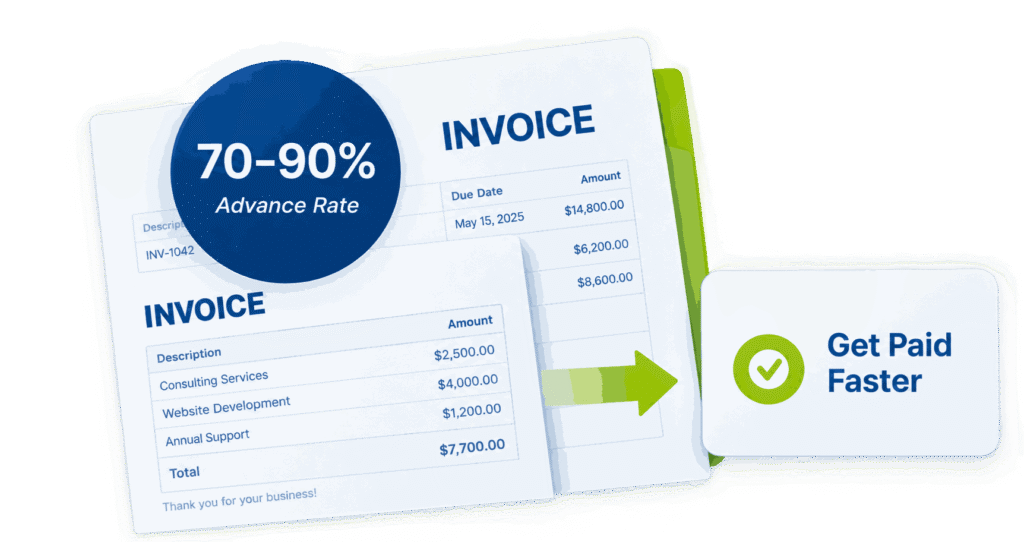
Accounts receivable (AR) financing also called invoice financing lets you borrow against unpaid customer invoices. Instead of waiting 30 to 90 days for clients to pay, you get 70% to 90% of your invoice value immediately as cash, with the remainder paid to you (minus a small fee) once your customer settles the balance.
How Accounts Receivable Financing Works
Apply and share receivables
Tell us about your business and share a list of your open invoices, often called an AR aging report, to get the process started.
Your customers are reviewed
The funding provider reviews your customers’ payment history and creditworthiness. Stronger customers mean better terms for you.
Receive your approved funds
Once approved, you receive 70-90% of eligible invoice value upfront. First funding takes a few days, then often within 24 hours.
Your customers pay invoices
Your customers pay their invoices as usual. Depending on the structure, payment goes to you or to the funding provider directly.
Receive the reserve balance
Once each invoice is paid, you receive the remaining amount, called the reserve, minus the agreed fee from the funding provider.
Accounts Receivable Financingvs. Invoice Factoring
These two terms are often used interchangeably, but there’s an important difference. Knowing which one you’re getting helps you choose the right fit.
Invoice Financing
- You keep full legal ownership of your invoices at all times.
- You continue collecting payments from your own customers.
- Customers usually don't know you're using financing.
- Best if you value customer relationships and have strong collections.
Invoice Factoring
- You sell your invoices to a factoring company at a discount.
- The factor collects payment directly from your customers.
- Your customers will learn a third party is involved.
- Often easier to qualify for and takes all collections off your plate.
Which is better?
Neither is better across the board. Invoice financing offers more privacy and control. Factoring offers easier approval and less administrative work. We’ll help you understand both options for your business so you can choose.
Who Accounts Receivable
Financing Is For
AR financing works best for businesses that:
- Sell to other businesses or government agencies, not to consumers.
- Invoice your customers on net payment terms of 30, 60, or 90 days.
- Have dependable customers with a strong history of paying on time.
- Are growing quickly and need more cash to keep up with new orders.
- Were turned down for a bank loan due to limited history or credit.
- Face regular gaps between when expenses are due and customers pay.
Who It's Not Right For
AR financing isn’t the right tool for every business. It’s probably not a fit if:
You sell mainly to consumers, not businesses.
Retail, restaurants and salons get paid at point of sale. Consider Business Revenue Financing or Merchant Cash Advances instead.
Your customers are slow or unreliable payers.
Funding depends on your customers paying. Invoices that are badly overdue usually aren’t eligible, so slow payers limit options.
Your invoices are in dispute, or conditional.
Work that is not complete, or invoices tied to unfinished milestones, generally cannot be financed until the conditions are met.
You need money for a large one-time purchase.
For equipment, real estate, or expansion, consider a Term Loan, SBA Loan, or Equipment Financing instead of receivables funding.
Your invoices are already financed or liened.
Existing liens on your receivables may need to be resolved first, and invoices already sold or pledged cannot be financed again.
Requirements
- B2B or B2G invoices for completed work or delivered goods
- Creditworthy customers with a history of paying on time
- Time in business of three to six months or more, though some providers work with newer businesses
- Consistent monthly invoicing, often starting around $10,000 per month
- Invoices that are current, typically less than 90 days old
- No conflicting liens on your receivables
- Basic documents, including your AR aging report, sample invoices, a business bank statement, and owner ID

- Right Funding
- Better Terms
- Business Growth
Benefits of Accounts Receivable Financing
Costs, Terms, and What to Expect
THE FINE PRINT
How Much Can You Get? A Simple Example
Recourse vs. Non-Recourse Financing
Recourse financing
- If your customer doesn’t pay, you’re responsible for repaying the advance or replacing the invoice with another one.
- Because you carry the risk, recourse arrangements usually come with lower fees and higher advance rates.
- Most AR financing is recourse.
Non-recourse financing
- The funding provider takes on the risk if your customer can’t pay due to insolvency or bankruptcy.
- That protection comes at a higher price.
- Non-recourse usually does not cover disputes over the quality of your work.
If your customers are large and stable, recourse financing is often the more cost-effective choice. If you’re concentrated in one or two customers whose finances concern you, non-recourse may be worth the extra cost.
AR Financing vs. Other Funding Options
- Business line of credit
- Term loan
- Purchase order financing
- Merchant cash advance
Industries That Use Accounts Receivable Financing
- Staffing agencies
- Trucking and freight
- Manufacturing
- Wholesale and distribution
- Government contractors
- IT, consulting, and business services
- Healthcare providers

Real-World Example
A staffing agency keeps payroll running while clients pay in 60 days
Tips to Get the Best Terms
Frequently Asked Questions About AI Lending Software
Yes, in many cases. If you have invoices from creditworthy business customers, you may qualify even with a short operating history.